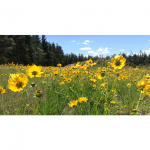
This article explores some practical ideas that will help you use nature to relax and de-stress. You’ll be able to take these ideas and experiment with them, practise the skills, and hopefully you’ll be able to help other people learn to use nature to relax as well.

Stress Mode vs Relaxation Mode
Humans are wired to easily go into a fear and stress mode. It’s a survival trait that’s helped our species to survive. But staying in stress mode is not helpful or healthy. It’s great for short term and emergency use but if you’re always in stress mode it’s no longer helpful and it can lead to chronic disease, a shortened life expectancy and generally less joy in your day to day life.
So how do you strike the balance between stress mode and relaxation mode? An interesting fact is that your body can be experiencing stress without you even realizing it. Your brain and your body can be so used to being in stress mode that it feels normal. To complicate matters even more, some of the things you enjoy doing in life can add to you body’s physiological stress response.
Most of us have strategies that we routinely use relax but some of these are more effective than others. Some strategies can make us feel good temporarily, but in fact they can contribute to our stresses. Alcohol is a good example of this. When you drink, you may experience a temporary feeling of relaxation but it can also trigger an unhealthy response in your body that may lead to dehydration, headaches, organ overloads and an altered brain state.
Nature and Relaxation
There are many natural ways to relax, and there are many things in nature that can help you relax. Whilst this article focuses on those parts of nature that are calming and soothing, it’s important to acknowledge that there are also many aspects of nature that might increase your stress response. For myself, the flies, mosquitoes and snakes in summer definitely trigger my stress response! When I’m using nature to relax, I won’t be bringing my attention to those things; I’ll think of other things in nature that bring me a sense of joy and calmness.
We all experience the world differently so what you find relaxing and soothing could be different to me or different to someone else who’s reading this post.
Step 1 – Connect with nature
The first step in this relaxation activity is to think of something in nature that is soo thing for YOU. If you have trouble doing this, it could be useful to conceptualise nature in the three different categories below and make a selection from one of them. (These are not scientific categories, but they are a useful way to organise your thoughts for the purpose of this activity.)
- Plants
- Animals
- Minerals (this includes inanimate objects such as still or running water, the sky, pebbles, breeze, rocks, boulders and sand)
Step 2 – get up close
Once you’ve identified something from nature that you find soothing, if possible, get up close to it (as long as it’s safe to do so!). For example, if a pebble is something that helps you to feel calm, centered and grounded, you can hold one in your hand. If you’re thinking of a creek, perhaps you can sit near it. You could also watch birds in a garden or run your hand through the sand. If it’s not possible to get up close, you can hold a photo or artwork that represents that thing, or have an audio recording that you can listen to.
Remember, it’s important to do this activity with something you find joy in so that you don’t get triggered into stress mode. Turn off or move away from any distractions for a few minutes including devices and other people if possible.
Step 3 – Relax body and mind
Now that you’ve made your selection and you’re up close to it, allow your body to become heavy. Allow your muscles to relax and go loose. Close your eyes if you feel safe to do so and simply focus on the feeling of your body softening and becoming heavy and melting into the ground or your chair beneath you.
When you’re in stress mode, your muscles tense up. In this activity you’ll be helping your muscles do the opposite. You’ll be helping your muscles rest and relax.
And when you’re in stress mode, your breathing also tends to get more rapid and shallow. As you relax with your chosen item, be aware of how your breath is going in and out of your body. Without forcing it, allow your breath to slow down and become deeper. Feel your breath nourishing your mind and your body.

Your heart rate also tends to go up when you’re in stress mode. Your heart is pumping blood around your body to keep your muscles tight and ready to jump or run at any moment. As your muscles relax and your breathing relaxes, your heart rate will also come down a little. That’s going to be a lovely rest for your heart.
You might find as you’re doing this activity that your mind races away; this is normal. Don’t try to control it. Training your thoughts is a bit like training an excited puppy that wants to dart here and there and all over the place. Be gentle with yourself, don’t scold yourself when you notice that your mind has wandered. Simply and gently bring your thoughts back to rest on your relaxing muscles or your breath. Your thoughts will be there later, you don’t need to go chasing them now, so just let them be.
Step 4 -Focus on nature
Once your body begins to feel relaxed, bring your attention to your chosen item or feature in nature. REALLY look at it, touch it, feel it, examine it. What does it look, feel, sound or smell like? Focus all your senses on your chosen item for a few minutes and give yourself permission to have this special time to simply enjoy this relaxed experience.
If your thoughts start telling you to hurry up or that you’re bored, just let them be. Bring your attention back to your body and your breath, to how you feel in this relaxed state, or to your chosen item.
Step 6 – Repeat regularly
You can repeat this activity regularly – every day would be fabulous! And you can use different things found in nature each time if you like. As you get more and more practised, you’ll be able to relax even when you’re not up close and personal with your chosen item. You’ll be able to do it by imagining or visualising being there.
A valuable hint: Practise when you’re NOT in a state of extreme stress, especially for the first few times. If you’re very stressed when you try to learn any new skill it can lead to frustration and increased stress levels. However once you become practised, your brain and body will be familiar with the process and you can more easily make it work for you even when you’re highly stressed. You can also use this activity to help you get to sleep or switch off after a busy day.
From Stressed to Relaxed With Nature
In summary, the idea behind this relaxation activity is to develop a relaxing association with something from nature that gives you joy, and to do that with minimal distractions. As you allow your muscles to become heavy and relaxed, bring your attention to your breath and very gently and slowly, deepen your breath. Focus on the rhythmic breathing in and out and you may find your heart rate will also come down a little bit. Using all your senses, bring your attention to your chosen item from nature and stay with it for a few minutes. When your mind wanders away, gently bring it back to your body, your breath or nature.
These are the powerful actions that will help you to counteract the stress response and trigger a relaxation response. It’s a simple idea, but one that needs practise. Once you’ve got the hang of it, you’ll be able to teach other people, including children, how to use nature to relax too.
Listen to the audio version of this post in the Outdoors is my Therapy Podcast Episode 24!
 Discovering mountain biking as life’s ultimate parallel universe in her middle age, Kathryn Walton shares information and reflections that inform, inspire and empower women to a healthy and active lifestyle.





 Kathryn Walton shares information and reflections in

 before we even set up camp we had a short walk around the area. A sudden loud rustle in the bushes next to us startled me. Turning around and expecting to see a wallaby, my daughter tells me I wouldn’t want to know what made that noise. On further enquiry she tells me it was a rather large snake, and I began to seriously wonder about moving our campsite further away from said snake.
 My uneasiness only increased as the evening rolled on and in particular when we came face to face with another snake only a few metres from our tents. Still, I wandered why the uneasiness was there in the first place. Was I sensing a spiritual presence? Was it simply that everything seemed strange and unfamiliar? Or perhaps the absence of other humans? Was I simply tired and misreading my intuition? Was it FEAR welling up and testing my inner strength?
 And so I survived. In fact I thrived and had possibly the best sleep so far on my April Adventure. I awoke before dawn, spent a couple of hours silently meditating, embracing my surroundings and feeling entirely captivated by what seemed so haunting and difficult the day before. I feel an immense sense of satisfaction that I didn’t allow my anxiety to rule and limit me. I chose to respect it but also to stand up to it. In doing so I’ve come to know an amazing spiritual aspect of this sacred land which I may not ever understand, but I can accept it and embrace it. And when I do that, I also accept and embrace myself.
 Daily exercise and general physical activity are crucial elements of feeling good. Just as some people might need to diligently take medication every day, I need to exercise every day. Exercise is nature’s way of stimulating the hormones which aid concentration, problem-solving, sleep, digestion, and mood. This daily dose of exercise rebalances our body’s systems resulting in wide-ranging benefits that no single medication can provide. The research is absolutely clear that regular medium to high intensity exercise can have a profound effect on health AND happiness.

 Minds are such complex things! They wield a lot of power over our emotions and our actions (including sleep). But unless you notice what’s going on in your mind, and choose how much power to give it, your thoughts, assumptions and beliefs will control you instead of the other way around. The habit of being hooked by thoughts or strongly attached to them is limiting and anxiety-provoking. The key here is to begin by simply noticing what is happening in your mind, and by doing this with curiosity and without judgement. The power is in the noticing. You’ll collect all sorts of interesting bits of information about how your mind works, what thinking patterns it gets locked into, what beliefs and assumptions are behind it all, and how all of this impacts your physiology, your behaviours and your emotions. One of my favourite sayings is “Don’t believe everything you think!” because we can learn to stand back, notice the thought and choose whether to believe it, or not.
 Click here to read my last blog post
 example of mine was
 You can collect them from songs, poems, books and social media in addition to listening to your own inner wisdom. Write them on sticky notes, in a journal or diary, print out visual reminders to stick around your home or workplace, or even use them as screen savers and wallpapers on your electronic devices. Some examples include “Just do it”, “One drop raises the ocean”, “Keep it simple”, “Just breathe”, “Stand tall”.
 lying on the beach, your stresses trickling away into the sand beneath you) or to help you progress towards a goal (eg visualise yourself speaking in front of an audience, feeling confident, upright posture, smiling, relaxed). When I’m feeling nervous about riding my bike on a particular section of track, I stop for a few moments and picture myself riding it the way I want it to go, as if I’m watching a short video of myself successfully negotiating that section. It truly is a powerful mind-based strategy and one you can use in every area of your life.
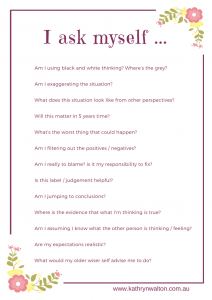 the mix. And to help you keep your strategies in play, I’ve created a free printable for you. “I ask myself …” is a beautiful keepsake of the helpful questions listed above. You can

 So, what are these foundation stones of wellness? There are four main foundation stones that I work on with my clients as well as in my own personal life. Each of the stones support each other – they are interlinked – and they are a fabulous place to start building or renovating wellness at any time! The foundations are based on solid evidence that is routinely used in the mental health sector.
 Basically, people are designed to move … a lot. When we don’t move enough, we are at greater risk of switching into a depressed or anxious state. It’s simple biology. Get moving, get active, get off the sofa, and move as much as you can and often as you can. For most of us it’s recommended to aim for about an hour of moderate intensity exercise or activity each day, and limit our screen time to 2 hours per day. The combined mental and physical health benefits of exercise / activity cannot be replaced by any medication. If you are in pain, or have limited movement, injuries, or chronic disease, the best idea is to do what you can. Remember always check with your doctor or health professional if you have any concerns about your health, exercise, and resting needs.
 3. Nutrition
 4. Mind